The Curiosity Gap
In 1994, a behavioral economist at Carnegie Mellon named George Loewenstein published a paper that would quietly become one of the most influential documents in the history of digital media — even though the internet barely existed at the time.
Loewenstein's paper, The Psychology of Curiosity, proposed what he called the information gap theory. The idea: curiosity isn't a desire to know everything. It's the specific discomfort of knowing just enough to realize you're missing something.
Think about how that feels physically. You remember a word but can't quite retrieve it. You hear a song but can't name it. There's a mild but persistent itch. Loewenstein argued this sensation is what drives curiosity — not wonder, not intellectual hunger, but the specific pain of an incomplete picture.
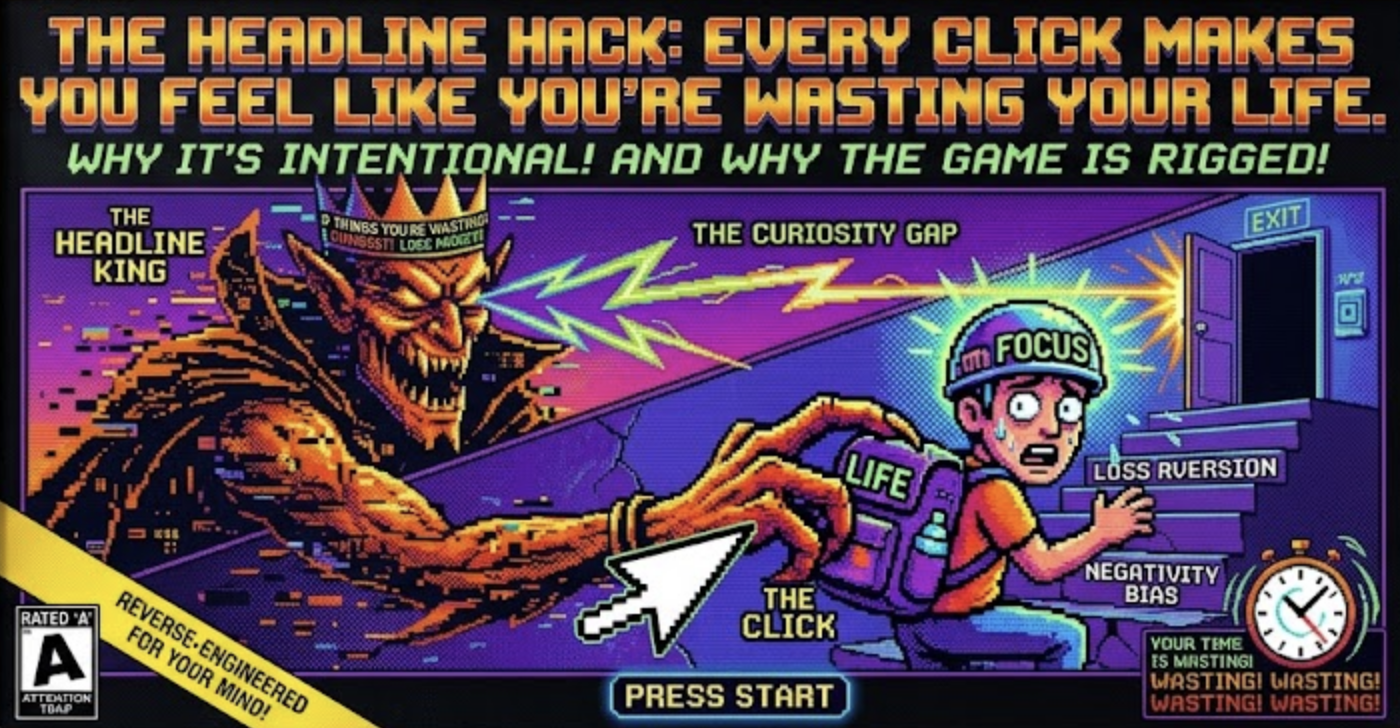
Headlines like "9 Dumbest Things You're Still Wasting Money On" are precision instruments for triggering that feeling. They don't tell you what the things are. They tell you there are things — things you're probably guilty of — and they withhold the list. The gap opens the moment you read the headline. The only way to close it is to click.
Upworthy, the viral content site that peaked around 2012–2014, codified this into a formula. Their internal editorial practice — which became widely known after internal documents circulated — reportedly required writers to produce around 25 headline variations per article and select the one that created the most compelling gap between what you knew and what you needed to know. Their traffic exploded. Every major publisher noticed.
Why "Dumbest" Works Better Than "Worst"
The word choice in these headlines isn't random either.
Notice that the headline isn't "9 Things You Might Want to Reconsider Spending Money On." It's "9 Dumbest Things." The moral judgment is built in. You might be dumb. You probably are.
This activates two well-documented psychological mechanisms at once.
The first is negativity bias — the brain's tendency to weight negative information more heavily than positive. In a 2001 paper titled Bad Is Stronger Than Good, psychologists Roy Baumeister, Ellen Bratslavsky, Catrin Finkenauer, and Kathleen Vohs reviewed decades of research and concluded that across almost every domain — memory, learning, emotion, social interaction — negative events have a stronger and more lasting impact than positive ones of the same magnitude.
This is an evolutionary inheritance. Missing a reward is a minor setback. Missing a threat can be fatal. Your brain has always been calibrated to react faster and more intensely to negative signals. A headline that implies you're doing something wrong, losing money, wasting time, or making yourself sick is activating circuitry that evolved to keep you alive. It's using a fire alarm to get you to click a link.
The second mechanism is loss aversion, a cornerstone of behavioral economics pioneered by Daniel Kahneman and Amos Tversky in their 1979 paper on Prospect Theory. Their research showed, across repeated experiments, that people feel the pain of a loss approximately 1.5 to 2.5 times as intensely as they feel the pleasure of an equivalent gain. Losing $50 typically hurts considerably more than winning $50 feels good.
A headline framed around loss — money you're wasting, time you're throwing away, mistakes you're making — hits harder than one framed around gain. Publishers know this. The "9 Best Ways to Save Money" headline and the "9 Dumbest Ways You're Wasting Money" headline contain essentially the same information. But the second one is pulling on levers that the first one isn't.
Why a Number? Why Always a Number?
The number at the front of the headline — the 9, the 11, the 7 — is doing specific cognitive work.
It creates what psychologists call schema congruence: your brain instantly recognizes what kind of reading experience it's signing up for. A list. Discrete items. Skimmable. Completable. The intuition is that this reduces the mental overhead of engaging with the article — you know the structure before you start. Research on cognitive load (the mental effort required to process and organize information) is well-established in educational contexts, though its direct application to listicles is more inference than demonstrated finding. The logic is reasonable; the specific claim hasn't been cleanly isolated in controlled studies.
Lists also exploit our preference for cognitive closure, a concept developed by psychologist Arie Kruglanski. People find comfort in things that feel finished. A list of 9 things has a beginning and an end. You can get through it. Compare that to a dense essay, which feels like an unbounded commitment. The list promises a transaction: a few minutes of your time, 9 complete pieces of information, done.
Some marketing studies suggest that odd numbers may appear more specific or credible to readers — a list of 9 things reads less like a round estimate and more like something someone actually counted. The findings on this are mixed and vary by context, but it's a widely repeated claim in digital publishing circles that odd numbers tend to outperform even ones in A/B tests. Whether that reflects genuine perception of rigor or something more mundane is not fully settled.
BuzzFeed discovered much of this empirically before the psychology research had fully caught up. Their analytics showed that list articles outperformed other formats in clicks and shares by wide margins. By 2013, the listicle had gone from a blog gimmick to the dominant format in online media.
Why Publishers Went All-In
Understanding why readers respond to this format explains why it spread. Understanding why publishers adopted it so completely requires understanding the economics.
Online media runs almost entirely on advertising. And advertising revenue is driven by page views — specifically, how many times ads are loaded. Every page view is a potential impression. Every impression is potential revenue.
In the early internet, publishers optimized for subscribers or loyal readership. Then Google and Facebook became the primary distribution channels for content, and the entire incentive structure shifted. Traffic now comes mostly from searches and social shares by people who have never visited your site before and probably won't again. The article doesn't need to serve a loyal reader. It needs to earn a click from a stranger, load some ads, and let them leave.
This created a perverse but logical optimization: maximize the emotional payoff of the headline while minimizing the cost to the publisher of producing the content. A list of 9 things often requires less production effort than a long-form narrative — no arc to sustain, no argument to develop, and the format lends itself to quick assembly. Some listicles involve substantial reporting; many don't. But as a format, it's far more scalable than in-depth journalism.
The analytic tools that emerged in the mid-2000s — Google Analytics, Chartbeat, later Parsely — made this feedback loop instantaneous and quantifiable. Editors could see, in real time, which headlines were driving traffic and which weren't. Decisions that used to be editorial judgment calls became optimization problems. The headline that performed better often won, regardless of whether the underlying article was any good.
A/B testing supercharged this. Tools like Optimizely allowed publishers to automatically test two headlines on live traffic and funnel readers toward whichever version got more clicks. Over thousands of iterations, the algorithm learned what human psychology already knew: negativity, numbers, curiosity gaps, and loss framing reliably win.
Why the Article Is Full of Padding
You've clicked. The headline worked. Now you're reading an article that seems to be doing everything possible to not tell you the thing it promised.
There's an introduction about how many Americans are bad with money. There's a paragraph about the history of consumer culture. There are pull quotes. There are headers. And then — just before item one — there's an ad.
This isn't poor writing. It's optimized writing, for a different goal than informing you.
Time on page is a metric that publishers track obsessively. More time on page means more ad impressions (ads often reload on a timer or as you scroll). It also signals to Google that the content is valuable, which improves search rankings, which drives more traffic. A short article that delivers its content immediately risks a quick bounce. A long article that slowly doles out information keeps you engaged longer.
Scroll depth matters too. Publishers know how far down most readers get on a given article, and they place higher-value ads at those depths. Padding is partly a structural mechanism for generating scroll behavior.
There's also a behavioral element worth naming. B.F. Skinner's research on variable-ratio reinforcement — where rewards come unpredictably rather than on a fixed schedule — found that this pattern produces the most persistent behavior in animals. The slot machine is the canonical example. Whether scrolling through a listicle activates the same neural circuitry as a lever-pressing rat is debated, and the analogy shouldn't be pushed too literally. But the behavioral pattern is similar enough to take seriously: some items will be obvious, some you've heard before, but one or two might genuinely surprise you. You don't know which ones. So you keep scrolling.
The Cost Nobody Tallies
There's a name for the byproduct of all this optimization: epistemic junk food.
The format has become so dominant that it shapes not just how content is delivered but what content gets made at all. Topics that lend themselves to lists get covered. Topics that require sustained argument or nuance don't. Publishing decisions that used to be driven by newsworthiness are now driven by predicted click-through rate.
The problem isn't that individual articles are shallow. It's that a media ecosystem optimized entirely for attention capture gradually degrades the shared information environment. Researcher Eli Pariser coined the term filter bubble in 2011 to describe how algorithmic personalization creates information environments that maximize engagement at the cost of breadth. A 2018 study published in Science by researchers at MIT found that false news stories spread faster and farther on Twitter than true ones — in part because false stories tended to be more novel and emotionally resonant, exactly the qualities that engagement algorithms favor. That study examined Twitter sharing behavior specifically, but its findings have been widely interpreted as indicative of algorithmic content distribution more broadly.
The individual click is harmless. Multiplied by billions of people, it funds and perpetuates a system that has structural incentives to be misleading.
So What Do You Do With That?
Knowing the mechanics doesn't make you immune. Loewenstein's curiosity gap still works on people who understand exactly what it's doing. Negativity bias doesn't switch off because you've read the research.
But it does give you something: a brief pause. A moment to ask whether you actually need to know the 9 dumbest things, or whether you just couldn't stand not knowing.
That pause is the only leverage you have. And it turns out, it's more than most people think to use.
Sources
- Loewenstein, G. (1994). The psychology of curiosity: A review and reinterpretation. Psychological Bulletin, 116(1), 75–98.
- Baumeister, R. F., Bratslavsky, E., Finkenauer, C., & Vohs, K. D. (2001). Bad is stronger than good. Review of General Psychology, 5(4), 323–370.
- Kahneman, D., & Tversky, A. (1979). Prospect theory: An analysis of decision under risk. Econometrica, 47(2), 263–291.
- Kruglanski, A. W., & Webster, D. M. (1996). Motivated closing of the mind: "Seizing" and "freezing." Psychological Review, 103(2), 263–283.
- Vosoughi, S., Roy, D., & Aral, S. (2018). The spread of true and false news online. Science, 359(6380), 1146–1151.
- Pariser, E. (2011). The Filter Bubble: What the Internet Is Hiding from You. Penguin Press.
- Sweller, J. (1988). Cognitive load during problem solving: Effects on learning. Cognitive Science, 12(2), 257–285.
- Peretti, J. (2014). "Both Time and BuzzFeed grew by creating irresistible lists." Pando, March 6, 2014.
- Dao, D. (2014). How BuzzFeed Thinks About Data Science. BuzzFeed.