The Man Who Built It Wants You to Know He's Sorry
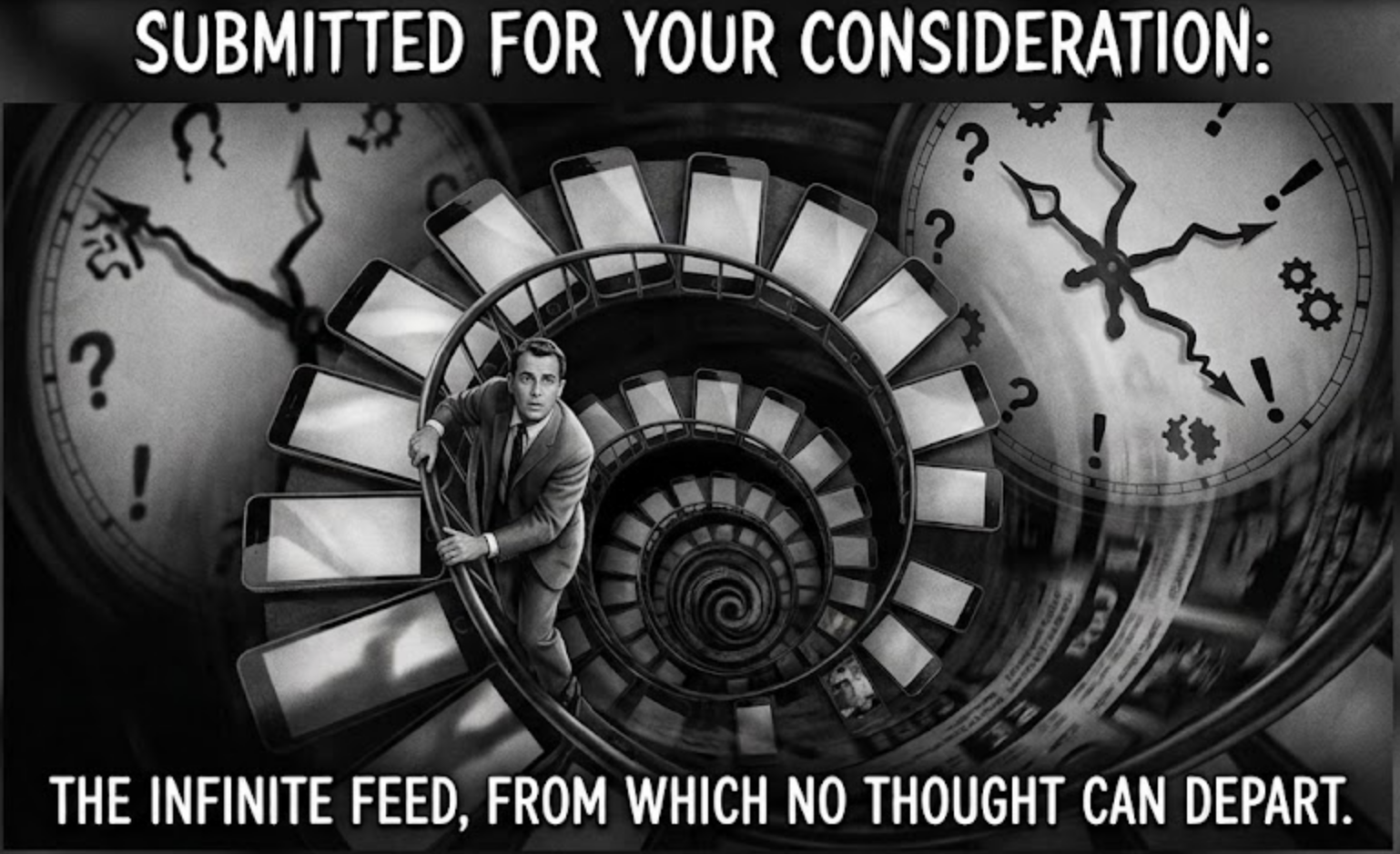
In 2006, a software developer named Aza Raskin was working at a company called Humanized when he designed a feature to make web browsing more fluid. The idea was simple: instead of loading a new page when you reached the bottom, content would just keep appearing. No clicking. No waiting. No natural stopping point. Infinite scroll.
It spread everywhere. Twitter adopted it. Facebook adopted it. Most major social platforms now use continuous feeds or closely related mechanisms — Instagram, TikTok, Reddit, YouTube all run on some version of the same idea. And in 2018, Raskin gave an interview to the BBC in which he said something that has been quoted ever since: "It's as if they took behavioral cocaine and sprinkled it on the interface."
He estimated that infinite scroll, across all its implementations, consumes roughly 200,000 additional hours of human attention per day — time people spend scrolling that they would not have spent if the page had simply ended. That figure is his own advocacy estimate, not a peer-reviewed finding, but the directional point is consistent with what platform analytics teams have documented internally. He has since become one of the more prominent voices in what is called the humane technology movement, which argues that the design choices baked into social media platforms are not neutral conveniences but deliberate manipulations of human psychology.
This is worth taking seriously, not because one regretful inventor says so, but because the underlying mechanisms he's describing are well-documented — and what they do to attention and behavior over time is increasingly a subject of serious research.
What a Stopping Cue Is, and Why It Matters
Before infinite scroll, every digital page had an edge. You hit the bottom, you saw a "next page" button, and you made a decision. That moment — small as it seems — is what behavioral researchers call a stopping cue: a signal that tells your brain the current episode is complete.
Stopping cues are surprisingly powerful. Research across multiple domains of consumption consistently finds that natural endpoints reduce how much people consume. In a study on what psychologists call unit bias, Andrew Geier, Paul Rozin, and Gheorghe Doros found that people treat a single discrete unit as the appropriate amount to consume — meaning individually portioned items lead to significantly less consumption than the same amount offered as a continuous supply. Research on television viewing has similarly found that distinct episode endings increase the likelihood that viewers choose to stop, while autoplay — which removes the inter-episode pause — substantially extends viewing time. The interruption itself creates a moment of deliberate choice that most people, given the chance, will use to stop.
Infinite scroll eliminates that moment entirely. There is no bottom to the page. There is no episode end. There is no natural break that prompts you to ask whether you still want to be doing this. The decision to stop has to come entirely from within — from willpower applied against a feed that never runs dry. For most people, most of the time, the feed wins.
Although Raskin originally designed infinite scroll as a usability improvement — eliminating the friction of page loads to make browsing more fluid — platforms rapidly discovered it also drove a more important metric upward: time-on-platform. More time on platform means more ads loaded, more behavioral data collected, more opportunities for engagement. Whatever Raskin intended, the feature was retained and expanded across the industry because it served platform revenue goals, not because it served users.
What Your Brain Is Actually Looking For
To understand why infinite scroll is so hard to stop, you need to understand something about how your brain handles novelty and reward — and a neuroscientist named Wolfram Schultz.
In the 1990s, Schultz and his colleagues at Cambridge discovered something unexpected about dopamine neurons. The popular conception of dopamine is that it's released when you experience something pleasurable — a reward arrives, dopamine fires, you feel good. But Schultz found that dopamine neurons don't primarily respond to rewards. They respond to the anticipation of rewards, and more specifically, to uncertainty about whether a reward is coming.
When a reward is guaranteed, dopamine activity stays flat. When a reward is possible but unpredictable — when you don't know if the next thing you see will be interesting — dopamine activity spikes. Your brain is fundamentally a prediction machine, and unpredictability is its most powerful activator. This is sometimes called the reward prediction error system: your brain is constantly comparing what it expected against what it got, and when the gap is uncertain, it keeps you engaged to resolve it.
A social media feed is optimized, deliberately or not, to exploit this system. The next post might be boring. It might be something that genuinely surprises or delights you. You don't know. That uncertainty keeps the dopamine system active in a state of low-grade, persistent anticipation. You keep scrolling not because each post is rewarding but because the next one might be — and your brain, calibrated for a world where novelty often mattered, can't easily let that possibility go.
This is different from "addiction" in the clinical sense, and it's worth being precise about that. Dopamine is involved in many motivated behaviors, not just pathological ones. But the mechanism — unpredictable rewards maintaining engagement — is the same one that makes slot machines hard to walk away from, and it operates below the level of conscious choice.
What It Does to Attention Over Time
The more interesting and less-discussed consequence of infinite scroll isn't what it does to you in the moment. It's what it does to your capacity for attention over months and years of habitual use.
Gloria Mark, a professor at UC Irvine who has studied attention and interruption for two decades, found in a series of studies that the average time a person spends on a given screen before switching has dropped significantly over the period she's been measuring it — from around two and a half minutes in 2004 to around 47 seconds by the early 2020s. Her research also documented a counterintuitive feedback loop: people who are frequently interrupted begin to interrupt themselves, switching tasks even when external demands aren't forcing them to. The expectation of interruption becomes internalized.
This matters because sustained attention — the ability to hold focus on one thing for an extended period — is not a passive capacity that either exists or doesn't. It's more like a skill that atrophies without practice. Work that requires deep focus, reading long-form material, following a complex argument, sitting with an uncomfortable problem — all of these become harder when the brain has been conditioned to expect constant novelty and to treat any lull as a signal to switch.
The mechanism here isn't that social media "rewires" the brain in some permanent, dramatic sense. The more accurate framing is that attention is shaped by what you practice. If you spend several hours a day in an environment that rewards rapid switching and punishes sustained engagement — which is exactly what an algorithmically curated feed does — your brain gets better at rapid switching and worse at sustained engagement. This isn't unique to screens; it's how learning works. The concern is the scale and consistency of the exposure.
What the Mental Health Research Actually Says
The relationship between social media use and mental health has become one of the more contested areas in psychology — partly because the effects are real, and partly because they're smaller and more complicated than the popular conversation suggests.
The loudest alarm has come from researchers like Jean Twenge at San Diego State University, whose work tracking generational data shows a notable rise in depression and anxiety among adolescents that correlates with the widespread adoption of smartphones and social media around 2012. Twenge has argued the correlation is meaningful and that the causal arrow points from phone use toward mental health decline, particularly for teen girls.
A significant reanalysis by Amy Orben and Andrew Przybylski, published in Nature Human Behaviour in 2019, pushed back. They reanalyzed large-scale survey data and found that the effect size of social media use on adolescent wellbeing was statistically small — comparable in magnitude to wearing glasses or eating potatoes. Their interpretation was that the panic about social media had outpaced the evidence, and that screen time as a variable was too blunt to capture what was actually going on.
The debate between these positions is ongoing and unresolved. What much of the research does converge on is that the type of use matters more than the total amount. A 2015 study by Philippe Verduyn and colleagues found experimental and longitudinal evidence that passive Facebook use — scrolling and consuming without interacting — reduced affective wellbeing, while active use did not produce the same effect. Social comparison driven by curated highlight reels correlates with lower self-esteem in multiple studies. And late-night use that displaces sleep is associated with mood and cognitive effects that track closely with the sleep literature rather than with any direct psychological impact of the content itself.
In other words: it's less about the scroll and more about what the scroll is replacing — sleep, face-to-face interaction, boredom, and the kind of idle mind-wandering that psychological research has linked to creativity and emotional regulation.
What Platforms Already Know
In 2021, Frances Haugen, a former Facebook product manager, provided internal company documents to regulators and journalists. Among other things, those documents included internal research showing that Instagram was aware its platform was associated with body image issues and depression in teenage girls — and that the company had deprioritized acting on those findings.
This is worth holding onto: the companies building these features are not operating in ignorance of the effects. They have large research teams running continuous experiments on user behavior. They know what features increase time-on-platform and which ones correlate with users reporting negative experiences afterward. The decision to ship infinite scroll, autoplay, algorithmically amplified outrage — these were not accidents of design. They were A/B tested, iterated on, and deployed at scale because they worked at keeping people on the platform. What they worked for and what they worked on you are two different things.
What You Can Actually Do
The honest answer is that willpower applied directly to infinite scroll is a poor tool. The feature exists specifically to defeat it. A feed designed to never end is not something you can simply decide to stop using through discipline alone — at least not reliably, over time, in the same way you can't reliably eat just a few chips from an open bag while watching television.
What does work, according to both behavioral research and the engineers who've spent time thinking about this, is changing the environment rather than fighting the impulse. Log out of apps after each use, which reintroduces the friction of logging back in. Move social apps off your home screen so opening them requires a deliberate action. Use app timers that force a stopping cue the platform has removed. Switch from apps to mobile browsers for social media, which are slower and less optimized and therefore easier to leave.
None of these are perfect solutions. They're friction — small obstacles that give the deliberate part of your brain a chance to catch up with the reflexive part. Which is, somewhat ironically, exactly what infinite scroll was designed to eliminate in the first place.
Aza Raskin has said he believes platforms should be legally required to offer users alternatives to infinite scroll — paginated feeds with natural stopping points that users can opt into. As of this writing, no major platform does this by default. A few have experimented with optional time limits. None have touched the scroll itself.
The feature that took an afternoon to design has turned out to be harder to undo.
Sources
- Raskin, A. (2018). Interview with BBC News: "Is infinite scroll making us unhappy?"
- Schultz, W., Dayan, P., & Montague, P. R. (1997). A neural substrate of prediction and reward. Science, 275(5306), 1593–1599.
- Mark, G., Iqbal, S., Czerwinski, M., & Johns, P. (2014). Bored Mondays and focused afternoons: The rhythm of attention and online activity in the workplace. CHI Conference on Human Factors in Computing Systems.
- Mark, G. (2023). Attention Span: A Groundbreaking Way to Restore Balance, Happiness and Productivity. Hanover Square Press.
- Orben, A., & Przybylski, A. K. (2019). The association between adolescent well-being and digital technology use. Nature Human Behaviour, 3, 173–182.
- Twenge, J. M., Haidt, J., Joiner, T. E., & Campbell, W. K. (2020). Underestimating digital media harm. Nature Human Behaviour, 4, 346–348.
- Geier, A., Rozin, P., & Doros, G. (2006). Unit bias: A new heuristic that helps explain the effect of portion size on food intake. Psychological Science, 17(6), 521–525.
- Sung, Y. H., Kang, E. Y., & Lee, W. N. (2018). Why do we indulge? Exploring motivations for binge watching. Journal of Broadcasting & Electronic Media, 62(3), 408–426.
- Verduyn, P., Lee, D. S., Park, J., Shablack, H., Orvell, A., Bayer, J., ... & Kross, E. (2015). Passive Facebook usage undermines affective well-being: Experimental and longitudinal evidence. Journal of Experimental Psychology: General, 144(2), 480–488.
- Haugen, F. (2021). The Facebook Files, as reported by The Wall Street Journal.